
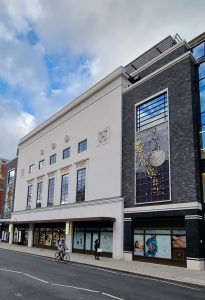
The Gaumont is an impressive development by Cadogan. It is currently being fitted out and is expected to be opened in Q4 this year by Curzon cinemas.
The main spaces at Curzon Chelsea will include:
The Main Stage – a 300-seat auditorium with Dolby Atmos sound and 4K projection, designed for premieres, screenings and large-scale events.
The Atrium – a central, flexible space for gatherings, receptions and live programming, with capacity for up to 300 guests.
Studio A – a highly adaptable studio supporting podcasts, writersʼ rooms, workshops and experimental screenings.
Studio B – a flexible screening and event space for up to 60 guests.
The Pod – a dedicated, fully equipped audio and video recording studio.
The Gallery – a bar, café and creative social space designed for informal working, meetings and day-to-day use
Curzon chairman and CEO Philip Knatchbull announced on 15th May 2026 “Curzon Chelsea reflects a rethinking of the role that Curzon holds at the cutting edge of the industry by creating a multi-purpose environment for the wider creative community. Our flagship location will span film, art, storytelling, content creation, podcasting, live performance and conversation-led events. In this sense, Curzon Chelsea brings together everything we have been envisioning for the future of Curzon and creative culture generally. Curzon Chelsea will operate as an all-day destination, maximising the use of the flagship location. Screening rooms, studios, production facilities, a restaurant and bar, and flexible event spaces will operate concurrently within a single, interconnected site, enabling people to meet, collaborate and develop in real time.”
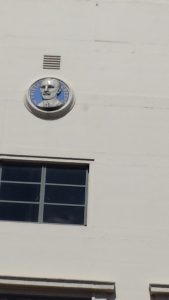
The building was named after Leon Gaumont, a French engineer who was one of the originators of cinematography.
Another was William Friese-Greene (1851-1921) whose basement workshop and studio was at 196 Kings Road (where the Gaumont now stands) and whose life is celebrated in the 1951 film “The Magic Box.” Starring Robert Donat. Perhaps they will show the film on opening day!
Friese-Greene was a society photographer, with studios in London, Bath, and Bristol. In 1889 he patented a “chromophotographic camera” – the first to use a roll of celluloid film to capture a sequence of images, but it captured only 5 frames per second and was not a commercial success. He also patented x-rays, 3D film, and two-colour cinematography. However, he died almost bankrupt in 1921!


